
News
125,000/Month! Zhongda Gallery's Rent Ledger: Cost Breakthrough and Survival Wisdom for Cultural Entities
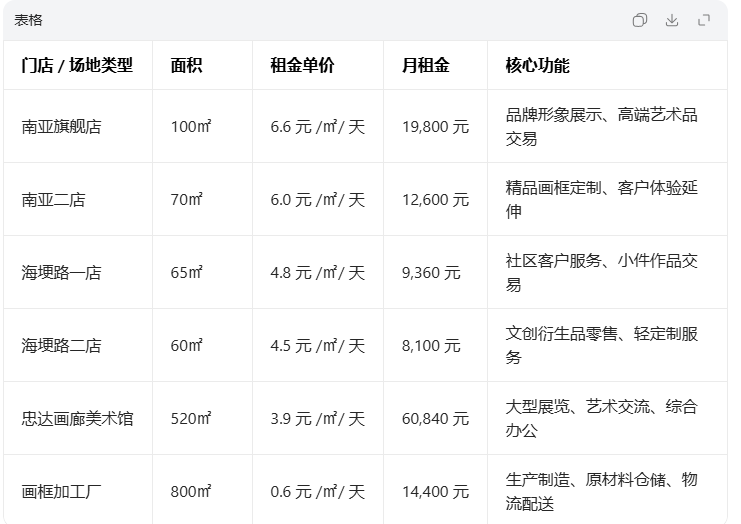
In Kunming's cultural and art sector, rent is an unavoidable 'rigid mountain'. With precise calculation as its anchor, Zhongda Gallery submitted a clear bill for the institution's total monthly rent of 125,100 yuan — store cluster 49,860 yuan/month, art gallery and production base 75,240 yuan/month. Every expenditure is anchored to the core business, hiding the pressure of physical operations while revealing the steady layout logic of a cultural brand.
A precise bill, deconstructing the rent cost structure
Zhongda Gallery's rent layout is a typical combination of 'core business district + industrial support', with each sector having clear positioning and transparent costs:
Looking at unit price distribution, the South Asia business district, with rent at 6.0-6.6 yuan/sqm/day, assumes the brand's 'facade' function, fitting the scene positioning for high-end art; the Haigeng Road area has rent as low as 4.5-4.8 yuan/sqm/day, undertaking daily services and retail with high cost-effectiveness, precisely covering the mass customer group; the 520 sqm art gallery and 800 sqm processing factory lock in the dual core capabilities of 'display + production' at low cost, supporting the brand's full-chain operation.
Behind the 125,000 Monthly Rent: The Cost Logic of Cultural Entities
The total rent of 125,100 yuan/month may seem significant, but it actually hides three major business wisdoms:
Functional partitioning, matching cost with value: Core business district stores undertake image display and high-end transactions, with rent premiums corresponding to high-value customer groups and brand exposure needs; community stores and production bases focus on service implementation and cost control, avoiding ineffective rent consumption, achieving the maximization of value: 'high-end in prime locations, efficiency in ordinary areas'.
Full-chain layout, a closed loop for cost reduction and efficiency improvement: The art gallery carries cultural functions such as exhibitions and exchanges, enhancing brand influence; the processing factory completes production and warehousing at a low cost of 0.6 yuan/sqm/day, ensuring supply chain autonomy while avoiding outsourcing costs, forming a 'display - service - production' full-chain cost control system.
Precise calculation, refusing blind expansion: The area, rent unit price, and function of each store are highly adapted, with no idle space and no redundant costs. Every inch of rent corresponds to clear business output, avoiding rent waste caused by 'expansion for the sake of expansion'. Breakout for Cultural Entities: Survival and Growth Under Rent Pressure
In today's culture and art industry, rent often accounts for 15%-25% of operating costs, becoming a 'stumbling block' to profitability for many entities. Zhongda Gallery's ledger provides three major references for the industry:
Precise site selection, balancing rent and customer flow: Store spaces in core business districts have high premiums but excellent customer quality; community and industrial support areas have low rents but require precise matching with customer needs. Cultural brands can adopt a 'dual-district layout', using core business districts to build image and regional stores to expand customer volume, controlling the rent ratio to within 15% of turnover for safety.
Functional integration, improving space utilization: For example, superimposing customization and experience functions in parts of the store to reduce independent venue rent; reasonably partitioning the art gallery and office area to avoid space idleness, turning every square meter of rent into actual value.
Industry chain extension, diluting rent costs: Laying out supporting bases like production and warehousing can ensure the core business remains autonomous and controllable, while achieving scale expansion at low cost, transforming from a 'single store' to a 'full-chain brand', and digesting rent pressure through business growth.
The vitality of cultural entities is hidden in every precise cost calculation. Zhongda Gallery's monthly rent bill of 125,000 is not just a piece of operational data, but a practical paradigm of 'precision layout, value matching, and full-chain operation'. In the current era of intensified industry competition, only by making every cent of rent correspond to clear business value can brands achieve steady growth and continuous breakthroughs amidst cost pressure.